If you are looking at Miami Beach waterfront property through a family-office lens, the purchase is rarely just about the home itself. You are evaluating a scarce coastal asset with layers of legal rights, tax implications, resiliency costs, and exit considerations that can shape performance over time. Understanding how sophisticated buyers assess these properties can help you make sharper decisions, whether you are buying for long-term use, capital preservation, or strategic optionality. Let’s dive in.
Waterfront value starts with the site
In Miami Beach, the land itself often carries as much importance as the residence sitting on it. The city describes Miami Beach as a barrier island between Biscayne Bay and the Atlantic Ocean, and it also frames its beaches as a critical economic, environmental, recreational, and protective asset.
That matters because family offices tend to focus first on what cannot be replicated. On waterfront sites, orientation, access to light and breeze, view corridors, and setbacks all affect how the property functions today and what it may support in the future.
Miami Beach’s design guidelines make that especially relevant on oceanfront and bayfront parcels. The city emphasizes view, light, and breeze corridors, stepped forms, and landscape planning in dune districts, while discouraging a continuous wall effect along the beach.
For you as a buyer, that means the siting of the asset is not a cosmetic detail. It is part of the core value proposition and can influence both enjoyment and long-term marketability.
Scarcity is only part of the story
Scarcity attracts attention, but regulation shapes outcomes. Miami Beach’s Resiliency Code serves as the city’s land-development framework, and the beachfront management plan is submitted to the state every 10 years.
For a major waterfront acquisition, this creates a more structured review environment than you may find in many inland markets. If you are thinking about redevelopment, expansion, or significant capital improvements, the rules around what can be built and maintained deserve early review.
Shoreline condition matters
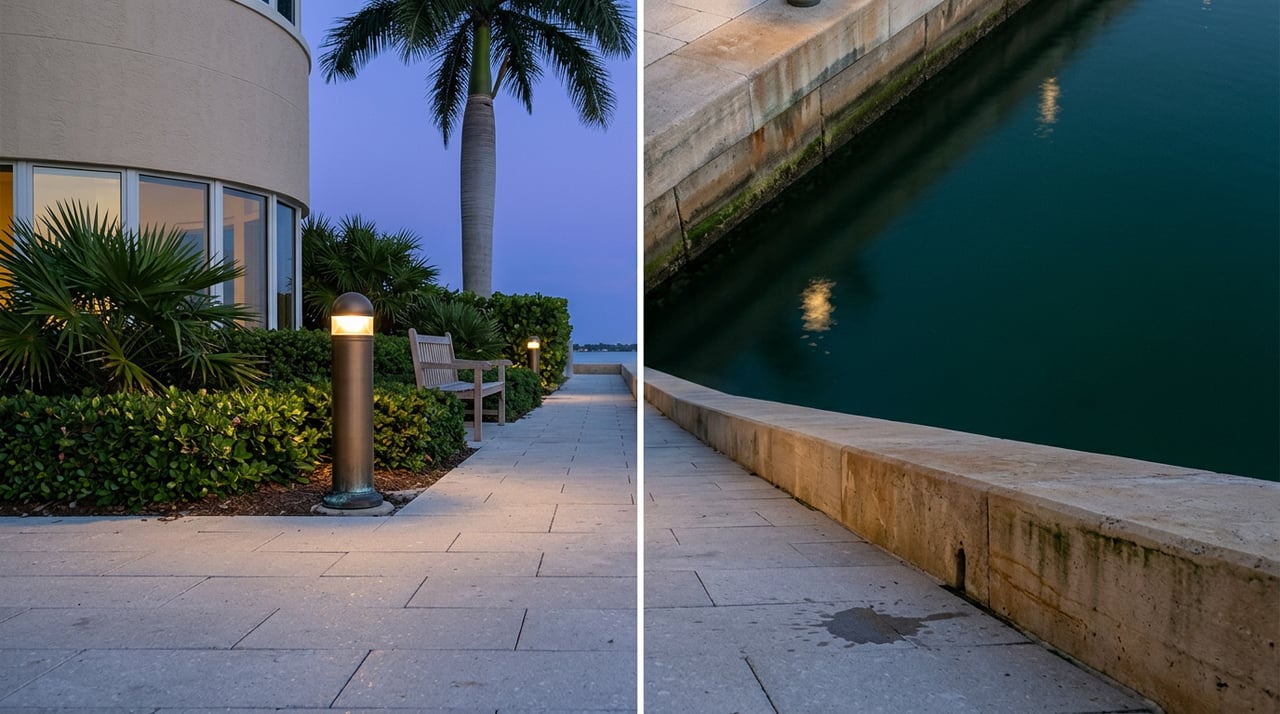
A waterfront address can come with major shoreline obligations. Miami Beach notes that the city is surrounded by 55 miles of seawall, while only 5 miles are publicly owned.
That makes private seawalls and shoreline interfaces a meaningful part of underwriting. Their condition, maintenance history, and likely replacement costs can materially affect your capital plan after closing.
Title and recorded rights shape liquidity
Experienced buyers know that clean ownership history supports smoother acquisitions and exits. In Florida, title diligence is especially important because recorded conveyances and liens can create constructive notice.
That is why prudent purchasers conduct title searches to identify mortgages, liens, easements, restrictions, and other potential defects. On a waterfront property, this review can be especially important when the asset includes shoreline features, access points, or recorded use limitations.
Family offices often think in terms of preserving a package of rights, not just taking ownership of a structure. When you buy a trophy waterfront property, you are also buying the legal use, the recorded history, and the ability to transfer that package later with minimal friction.
Provenance does not stop at closing
Ongoing ownership monitoring also plays a role. Miami-Dade offers free property-fraud alerts that notify owners within 24 hours if a deed or mortgage is recorded in their name.
For high-value assets, that can be a practical layer of post-closing protection. It also fits how many family offices approach ownership, with an emphasis on stewardship as well as acquisition.
Florida’s tax profile is part of the appeal
For many principals and capital allocators, Florida’s jurisdiction-level tax profile is one of the clearest structural advantages. According to the Florida Department of Revenue, the state does not impose personal income tax, inheritance tax, gift taxes, or tax on intangible personal property.
Florida estate tax also ended for deaths after December 31, 2004, and no Florida estate tax is due for decedents dying on or after January 1, 2005. That broader tax backdrop is one reason Miami Beach remains relevant in conversations about lifestyle, capital preservation, and long-term ownership planning.
Of course, that does not mean every tax question disappears. The Department of Revenue notes that many businesses remain subject to corporate income tax and other taxes and fees, so your specific ownership and use structure still needs careful review.
Property taxes require conservative modeling
In Miami-Dade, property taxes should be modeled carefully rather than estimated from the seller’s current bill. The county property appraiser warns that a change in ownership may reset assessed value to full market value, which can materially increase taxes after closing.
The annual process also matters. The property appraiser sends value and exemption information, the TRIM notice estimates the November tax bill, taxing authorities levy against taxable value, and the Tax Collector mails the bill in November.
You also need to account for non-ad valorem assessments. These can include CDDs, special assessment districts, and PACE districts, and they sit on top of ad valorem taxes in the total carrying-cost picture.
Homestead is not always part of the plan
Homestead benefits can be meaningful for qualifying permanent residences, but they are not universal. Florida states that homestead can reduce taxable value and that Save Our Homes can cap annual assessed-value growth.
Still, Miami Beach warns that short-term rental use can result in the loss of the homestead exemption. For a pied-à-terre, investment property, or flexible-use waterfront asset, many sophisticated buyers do not treat homestead upside as part of the base underwriting case.
Rental optionality depends on zoning
Waterfront buyers sometimes assume premium addresses automatically come with premium rental flexibility. In Miami Beach, that assumption can create serious underwriting errors.
The city states that vacation and short-term rentals are prohibited in all single-family homes and in many multifamily buildings in certain zoning districts. If a property is permitted for that use, it must have a Business Tax Receipt and a Resort Tax account, and advertisements must display those numbers.
That means any projected short-term income should be verified against the exact zoning map and legal use status of the property. Family offices typically want confirmed use rights before they assign value to any income strategy.
Not every trophy asset is an income asset
Miami Beach defines vacation and short-term rentals as stays of less than six months and one day. As a result, many waterfront assets are better underwritten as long-term or seasonal-use properties rather than as hotel-like inventory.
This distinction can have a direct impact on pricing, ownership structure, and exit strategy. A property may be exceptional as a lifestyle or preservation asset even if it has limited transient-rental optionality.
Flood exposure must be measured, not assumed
On Miami Beach waterfront, flood risk is part of the asset analysis. It should be mapped, quantified, and reviewed against both current conditions and possible future changes.
FEMA identifies the Flood Map Service Center as the official public source for flood-hazard information, and flood maps are updated over time. High-risk zones begin with A or V, and V zones represent coastal high-hazard areas with special floodplain-management requirements, including elevation on piles or columns.
Miami Beach also advises owners to review both current and preliminary flood maps. A map change can alter flood zone classification and base flood elevation, which can affect insurance, renovation scope, and resale planning.
Resiliency is now part of value
In today’s market, family offices often treat adaptation capacity as part of the asset itself. Miami Beach’s 2026 Fight the Flood program offers up to $20,000 in reimbursement grants for eligible mitigation work, including building elevation, seawalls, temporary barriers, permeable pavers, raingardens, floodwalls, French drains, interior floor elevation, and protection for mechanical systems.
The city’s broader design and seawall initiatives reinforce the same point. Flood adaptation is not a side issue in waterfront underwriting. It is part of the long-term cost, usability, and durability of the property.
Condo diligence is its own discipline
For waterfront condominiums and penthouses, the building itself deserves a separate diligence track. A beautifully finished unit may still sit inside a building facing significant reserve needs or future assessments.
Florida law requires milestone inspections for residential condominium and cooperative buildings that are three or more habitable stories, generally at 30 years and every 10 years after that, with a 25-year trigger possible in certain local circumstances. The purpose is to identify substantial structural deterioration.
Florida also requires a Structural Integrity Reserve Study for key building elements such as the roof, structural systems, fire protection, plumbing, electrical, waterproofing and exterior painting, windows and exterior doors, plus other major items affecting structural integrity. If reserves are inadequate, associations may need special assessments, loans, or lines of credit.
Why condo financial health matters
For you as a buyer, this means a luxury tower’s financial position can be just as important as a residence’s views, layout, or finishes. Inspection reports, reserve schedules, and any proposed assessments should be part of pricing discussions before you commit.
In the family-office context, this diligence helps separate a visually impressive asset from a fundamentally well-capitalized one. That distinction can affect holding costs, financing assumptions, and future liquidity.
Questions sophisticated buyers ask first
When family offices evaluate Miami Beach waterfront assets, their early questions are usually practical and layered.
They often include:
- Is the property in a current or preliminary flood zone, and if so, is it an A or V zone?
- Is the intended use legally allowed under Miami Beach zoning and short-term rental rules?
- What liens, easements, restrictions, seawall obligations, or title exceptions appear in the recorded history?
- Will the purchase reset assessed value, and are there non-ad valorem assessments attached to the folio?
- If the asset is a condominium, are milestone inspection, reserve-study, and funding requirements current?
These questions help shift the conversation from surface appeal to asset quality. In Miami Beach, that is often where the best decisions are made.
The bottom line for Miami Beach waterfront
The most sophisticated waterfront buyers do not stop at the view. They look at whether the property can support that view, preserve its legal rights, carry its tax burden realistically, adapt to flood exposure, and remain efficient to own or sell over time.
That is why Miami Beach waterfront underwriting often centers on a package of scarcity, lawful use, title quality, resiliency, and ongoing capital obligations. If you are evaluating a bayfront estate, a penthouse, or a premier condo residence, a disciplined process can protect both upside and peace of mind.
If you want discreet guidance on Miami Beach waterfront opportunities, off-market access, or buyer representation grounded in local expertise, Shayna Hanson can help you evaluate the details that matter most.
FAQs
How do family offices evaluate Miami Beach waterfront properties?
- They often assess the asset as a combination of scarce land, legal use rights, title quality, tax exposure, flood risk, and long-term capital needs rather than as a simple residential purchase.
What tax issue matters most when buying Miami Beach waterfront real estate?
- A key issue is that a change in ownership may reset the assessed value to full market value in Miami-Dade, which can increase property taxes after closing.
Are short-term rentals allowed in Miami Beach waterfront homes?
- Not always. Miami Beach says vacation and short-term rentals are prohibited in all single-family homes and in many multifamily buildings in certain zoning districts, so you should verify legal use before underwriting rental income.
Why is flood-zone review important for Miami Beach waterfront assets?
- Current and preliminary flood maps can affect insurance, renovation costs, elevation requirements, and resale planning, especially if a property falls in an A or V flood zone.
What should buyers review before purchasing a Miami Beach waterfront condo?
- Buyers should review milestone inspection reports, the Structural Integrity Reserve Study, reserve funding, and any proposed special assessments because building financial health can affect true ownership cost.